What superelevation means for an abnormal load route
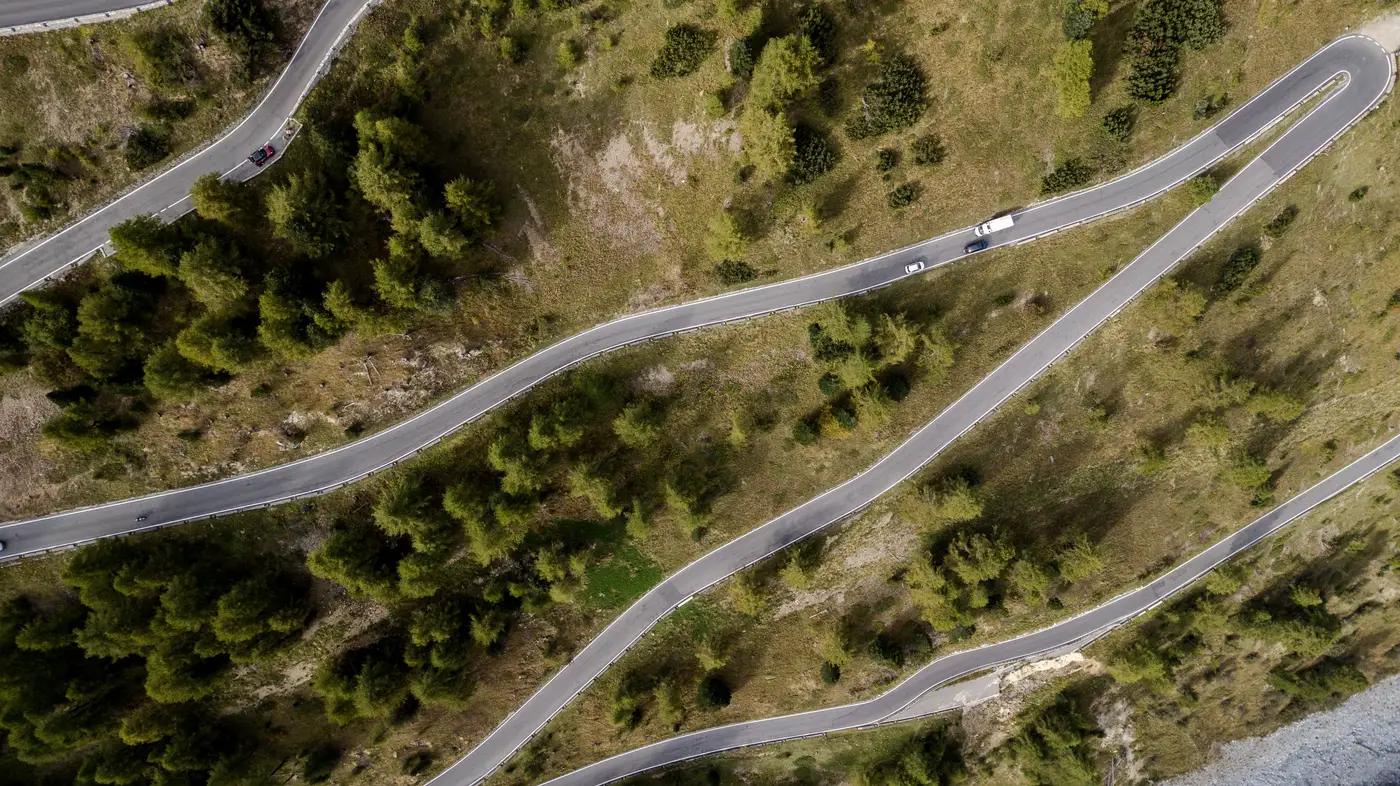
What superelevation actually is
Superelevation is the engineering term for the bank on a curve: the cross-slope built into a road so a vehicle can carry speed through a bend without sliding toward the outside edge. Highway engineers size it for passenger cars at the posted speed limit. Nobody on that design team was thinking about a 42-metre blade segment riding a modular trailer at 15 km/h with the center of gravity six meters off the deck.
That gap matters more on a banked curve haul route than almost anywhere else in the route plan.
Why a banked curve changes the math for an abnormal load
A standard sedan uses superelevation the way it's meant to work. The bank counters centrifugal force at normal speed, grip stays even, nobody notices the engineering underneath them. An abnormal load crawling through the same curve doesn't get that benefit. At low speed the rig isn't fighting centrifugal force much at all, so the bank angle does something closer to the opposite of its design intent: it tilts the trailer bed and the load together toward the low side of the curve.
Add crosswind and the math gets worse fast. Crosswind rollover risk on an oversize load is a function of sail area, the blade's flat surface broadside to the wind, and ground clearance. Stack that on top of a curve where the road is already leaning the load several degrees off level, and the tipping point moves a lot closer. A gust a loaded flatbed would shrug off on flat tarmac can be the difference between a clean pass and a load on its side, on a curve banked the wrong way relative to wind direction.
Camber, the everyday crown built into most rural roads to shed rainwater off the centerline, compounds this on the straights leading into and out of the bend. A road camber constructability screen looks at both: the engineered superelevation through curves and the ordinary crown along the approach. A trailer carrying a wide load high off the deck can pick up meaningful lean from camber alone before it ever reaches the curve.
What this means before the haul plan is committed
None of this shows up on a standard route map, and most of it doesn't show up clearly from a vehicle windshield either. A pilot car crew can feel that a curve is tight or banked, but by the time they're out there with a tape measure the haul plan is usually already committed, the permits are filed, and the schedule has a date on it. Finding a superelevation problem at that stage means a reroute, a redesign of the transport configuration, or an uncomfortable call to the site.
The cheaper place to catch it is at the desk, before the survey crew is booked. A route-and-site read from high-resolution imagery can flag the curves where bank angle, bend radius, and approach camber are likely to interact badly with a given load's width and center of gravity, and flag which of those sit on stretches with meaningful crosswind exposure too. It doesn't replace engineering judgment on the specific rig and load, but it narrows a full route down to the handful of bends that actually need a closer look.
That's the gap Constructability Screening is built to close: a constructability read on the route and the site before anyone commits a haul plan to paper.
If a route to your next renewables site has banked curves you haven't screened yet, that's worth a look before the pilot car goes out.