How to check roundabout geometry before routing a blade trailer
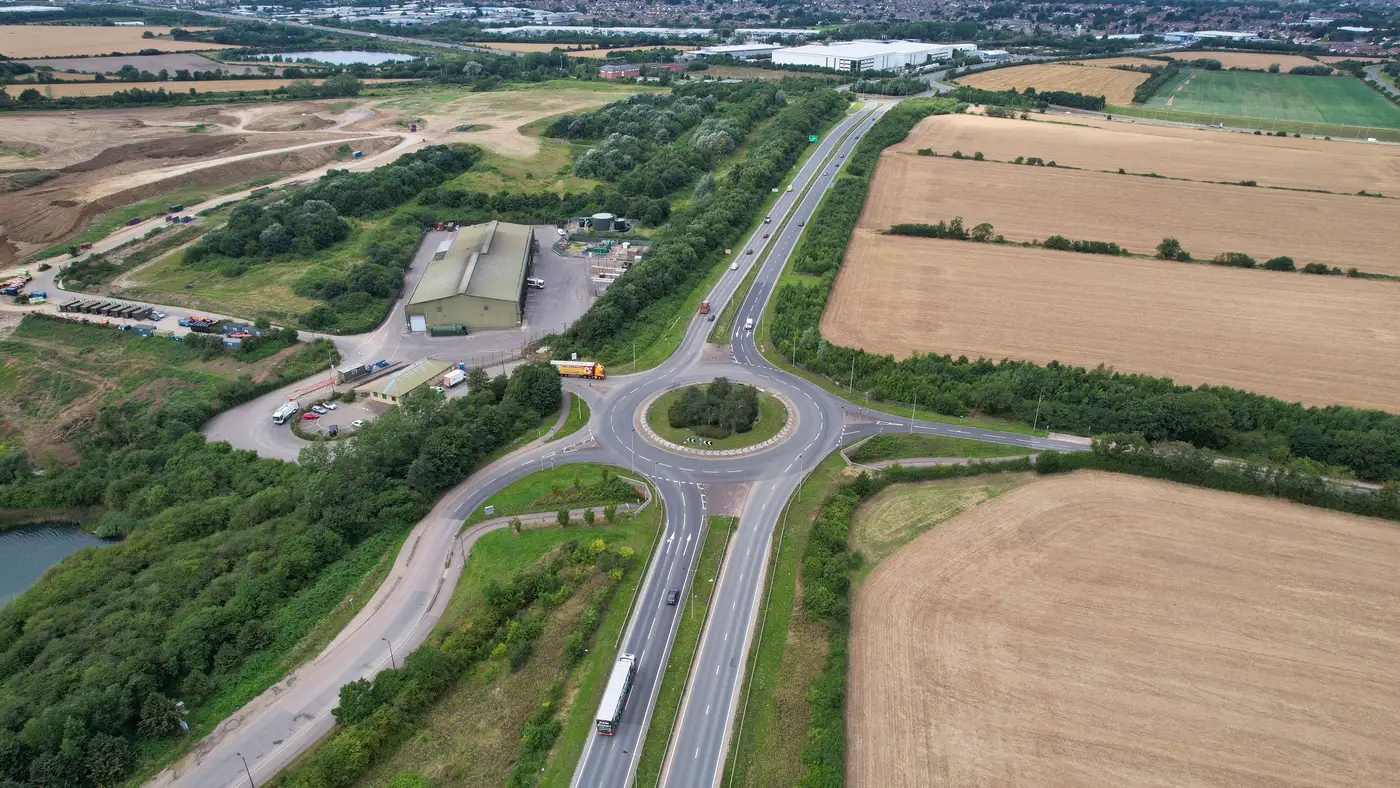
A roundabout looks like a non-event on a route plan. It's one more intersection, lower speed, no signal timing to track. Then the swept path check runs and the pivot point on a blade dolly walks into the splitter island, or the tip overhang catches a sign mounted on the truck apron. These intersections cause more revised haul plans than almost any other feature on a renewables route. They deserve a closer look before a pilot car ever leaves the yard.
Traffic circle vs roundabout for long loads
People use "traffic circle" and "roundabout" interchangeably, but the geometry behind each term is different for a long load. Older circles often run larger diameters, gentler entry angles, and sometimes multiple lanes with a weaving section. Newer roundabouts, especially ones built or rebuilt in the last two decades, are deliberately tight: a smaller inscribed circle, sharper deflection on entry, and a raised or mountable strip around the center meant to slow cars down, not haul trailers across.
That raised strip is the detail that matters most for a blade trailer. It's built so a car's rear axle can ride up over it for a second. Forty-plus tons of tractor, dolly, and a blade well over a hundred feet long crawling across it is a different load case entirely. A rig that could swing wide through an old-style circle without touching anything can need the full width of that strip on a modern design, and sometimes still come up short.
What to check before committing to the route
A real swept path through this kind of intersection isn't eyeballed off a zoomed-out satellite image. It comes down to a handful of measurements that stack on top of one another and have to be checked as a set, not a single pass/fail number.
- Inner radius clearance. The tightest point of the turn is where the kingpin or pivot axle tracks closest to the center island. On a small inscribed circle, this is where the rig either rides the mountable strip or doesn't make the turn.
- Outer radius and entry lane width. The tractor can sit well inside its lane while the blade tip, still 60 or 80 feet back, is already over the far curb.
- Splitter islands. These raised islands narrow the approach at each leg and catch overhang on the tip or the trailer frame before the wheels get anywhere near them.
- Construction of the raised strip. Painted and mountable reads the same from a distance as paved and load-rated, but they aren't. Some of these strips are decorative brick that won't take trailer weight.
- Gradient through the intersection. A banked or crowned design changes the effective swing of a long trailer mid-turn in a way a flat four-way never does.
- What's planted or built on the center island. Landscaping, signage, or a monument sign all sit inside the path a blade tip can realistically sweep.
None of this shows up on a highway-speed route survey. It shows up when someone pulls the actual curb lines and lane widths and runs the trailer's known turning template against them.
Reading the geometry before the pilot car drives it
This step gets skipped under schedule pressure more often than anyone likes to admit. A planner counts the intersections on a map and assumes the ones without an obvious red flag are fine. Then the pilot car finds out otherwise at the one leg nobody flagged, usually with a loaded trailer already committed to the approach and nowhere left to back out.
Checking inscribed diameter, apron construction, and splitter island placement against a blade trailer's swept path before the haul plan locks in is exactly the kind of desk check that catches this early. Constructability Screening reads that geometry, along with bend radii, bridge spans, gradients, and laydown space for the rest of the route, straight from high-resolution imagery, so an intersection that won't take the load gets flagged before a survey crew drives out to confirm it in person.
A quick gut-check for planners in a hurry
If an intersection on the route was built or rebuilt recently, has a visibly raised center, or sits on a road where the state DOT has been standardizing design, treat it as a candidate for a real check rather than a drive-through guess. Small, new, and tidy is usually the combination that catches a long load off guard.
Send over the route and the project site, and get a constructability read before the haul plan locks in.